
Summer Sports Start This Week. Is Your Kid’s Body Ready?
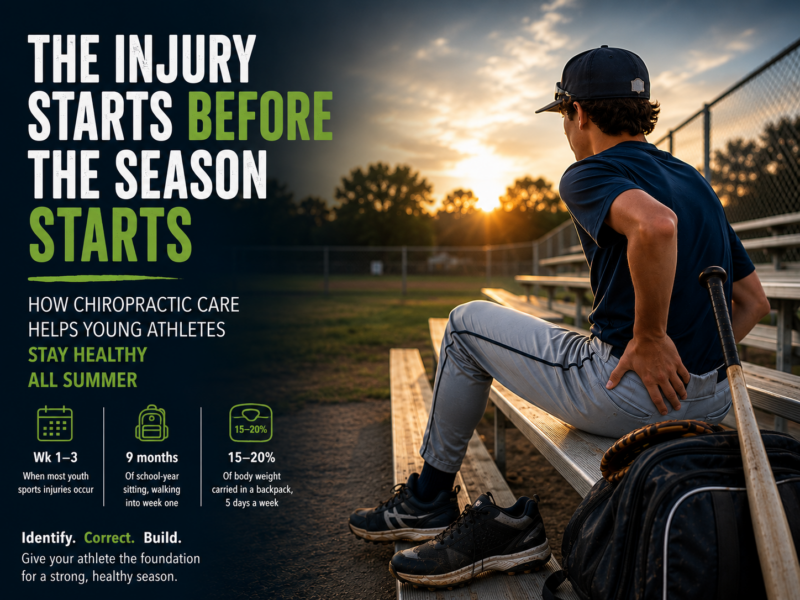
Is Your Young Athlete Ready for Summer Sports?
School’s out. Camps are starting. Practice schedules are filling up.
And across Fort Wayne, young athletes are about to ask their bodies to do a lot more than they’ve done in the last nine months.
The problem?
Most summer sports injuries don’t begin on the field.
They begin long before the first practice.
Meet Tyler — Age 14
Tyler plays travel baseball and just started his summer conditioning program.
He’s spent the last nine months sitting in class, carrying a heavy backpack five days a week, and squeezing in a workout whenever school, homework, and finals allowed.
His mom bought new cleats.
His dad got him a new batting glove.
Nobody asked about the hip that had been “a little tight” since March.
First practice is Thursday.
Tyler isn’t unusual.
In fact, he’s exactly what we see every summer.
Young athletes go from months of sitting, studying, and inconsistent activity to daily practices, weekend tournaments, camps, conditioning sessions, and long days in the heat.
The body that spent spring hunched over a desk is suddenly expected to sprint, cut, throw, rotate, jump, and recover like it’s been preparing for months.
Sometimes it can.
Sometimes it can’t.
And that’s when injuries happen.
Most Youth Sports Injuries Are Predictable
Parents often describe injuries as bad luck.
A pulled hamstring.
A sore shoulder.
A knee that suddenly started hurting.
But many of the injuries we see weren’t random at all.
They were developing quietly for months.
A mobility restriction.
A movement imbalance.
A compensation pattern.
A growing athlete whose body adapted to sitting more than moving.
Then summer arrived and the workload exposed what was already there.
“The injury at week three of the season usually started at week one—or before the season even began. The body was already compensating. We just didn’t know it yet.”
By The Numbers
Week 1–3
When many youth sports injuries occur.
9 Months
The amount of time most athletes spend in school before summer sports begin.
15–20%
Average backpack weight relative to body weight for many students.
What Nine Months of School Does to an Athlete’s Body
The school year creates a slow accumulation of physical stress that rarely gets noticed until activity levels increase.
Hours of sitting tighten hip flexors.
Glutes become less active.
Thoracic spine mobility decreases.
Forward-head posture becomes the norm.
Heavy backpacks create asymmetries in the neck, shoulders, and upper back.
None of these issues automatically create pain.
That’s why they often go ignored.
But when a young athlete suddenly increases training volume, those small compensations become significant.
The body runs out of margin.
That’s when the “freak injury” happens.
Except it wasn’t really a freak injury at all.
How Chiropractic Care Helps Young Athletes
At Allen County Family & Sports Chiropractic, our goal isn’t simply helping athletes feel better.
Our goal is helping them move better.
When movement improves, performance improves.
And injury risk often decreases.
Restore Mobility and Alignment
Months of sitting create predictable restrictions in the spine, hips, and shoulders.
Chiropractic adjustments help restore normal joint movement and reduce the compensations that force other areas of the body to work harder than they should.
For a baseball player, thoracic rotation influences throwing mechanics.
For a soccer player, hip mobility affects knee and low back stress.
For every athlete, movement quality matters.
Address the Real Cause
Pain isn’t always the problem.
Often it’s the warning signal.
A knee issue may start at the hip.
A shoulder problem may begin with poor thoracic mobility.
A recurring muscle strain may be the result of a movement pattern that’s been compensating for months.
Rather than focusing only on where symptoms appear, we evaluate the entire movement system.
That’s often where the real answers are found.
Build Better Movement Patterns
Adjustments create the foundation.
Movement coaching, soft tissue work, and corrective exercises help athletes keep the changes.
The goal isn’t simply short-term relief.
It’s creating a body that can tolerate the demands of a long season.
A stronger foundation helps athletes move more efficiently, recover more effectively, and stay in the game longer.
“Strong, well-aligned bodies don’t just perform better. They handle the demands of a full season without breaking down in the middle of it.”
What Parents Should Watch For
Kids rarely tell you everything hurts.
Most don’t want to miss practice.
Most don’t want to lose playing time.
Most assume discomfort is normal.
Pay attention if you notice:
- One side consistently feels tighter than the other.
- A nagging ache that’s been hanging around since spring.
- Morning stiffness that lingers after practices.
- Complaints of heel, knee, or growth-related pain.
- Uneven shoulder height.
- Difficulty lifting both arms overhead equally.
- A noticeable change in running, throwing, or movement mechanics.
These signs often show up before a significant injury does.
According to the American Academy of Pediatrics, gradual increases in training load, proper recovery, and early attention to movement issues can help reduce injury risk in young athletes.
The Earlier You Address It, The Easier It Is
A movement restriction caught in June is easier to address than the same issue in August after weeks of compensation.
That’s true for adults.
It’s even more true for growing athletes.
Waiting until something becomes painful usually means the problem has been developing for quite a while.
Proactive care gives athletes the opportunity to start the season with a body that’s ready for the workload ahead.
Back to Tyler
Tyler came in two days before his first practice.
What seemed like “a little hip tightness” turned out to be a restricted SI joint and a significantly tighter left hip flexor.
Nothing severe.
Nothing dramatic.
But enough to alter how he moved.
Two visits before the season started helped restore mobility and reduce the compensation pattern that had been building for months.
Four weeks later his coach pulled him aside and told him he was moving better than he had all of last season.
His mom said it was the best money she’d spent all summer.
Protect the Season Before It Starts
Summer sports are here.
The question isn’t whether your athlete will train hard.
The question is whether their body is prepared for what’s coming.
A chiropractic evaluation can help identify mobility restrictions, movement imbalances, and compensation patterns before they create bigger problems.
Because the best time to address an injury risk isn’t after the injury.
It’s before the season starts.
Schedule an Appointment
If your athlete is preparing for summer practices, camps, tournaments, or conditioning, we’re here to help.
At Allen County Family & Sports Chiropractic, we help young athletes move better, recover better, and stay active throughout the season.
Call today to schedule an appointment and learn how chiropractic care can support your athlete this summer.
